We couldn't find a solution on the current market that met our expectations.
Our EMS was developed as proprietary software so that we could have full control over energy technology management and offer our customers solutions that truly correspond to today's energy sector. It was designed by a team of IT and energy specialists and combines work with data, predictions, operational logic, and economic management. Thanks to its cloud-native and API-first architecture, it can be easily expanded, connected to other systems, and operated from anywhere, without the limitations typical of universal third-party platforms.
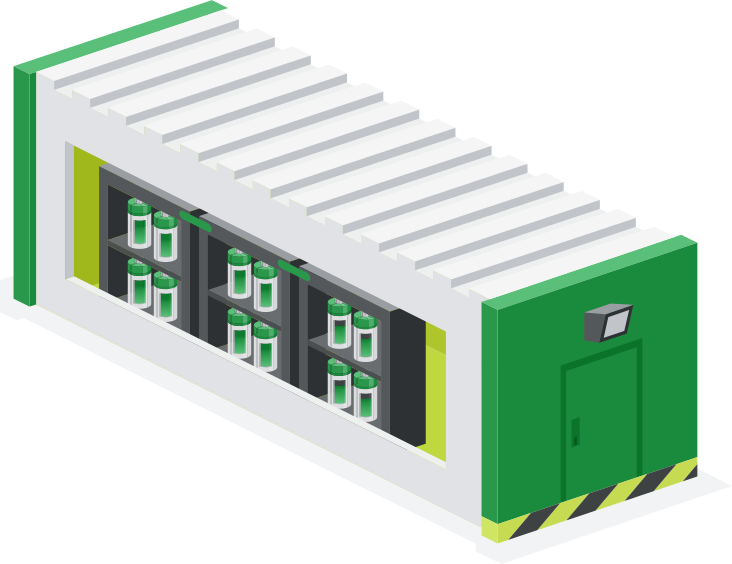
At the basic level, EMS ensures the safe and stable operation of the entire storage facility. It controls communication with batteries, inverters, safety features, HVAC, heating, and fire systems, and keeps all components in a defined mode without the need for operator intervention. It thus forms a reliable foundation on which higher predictive and economic logic can be built.
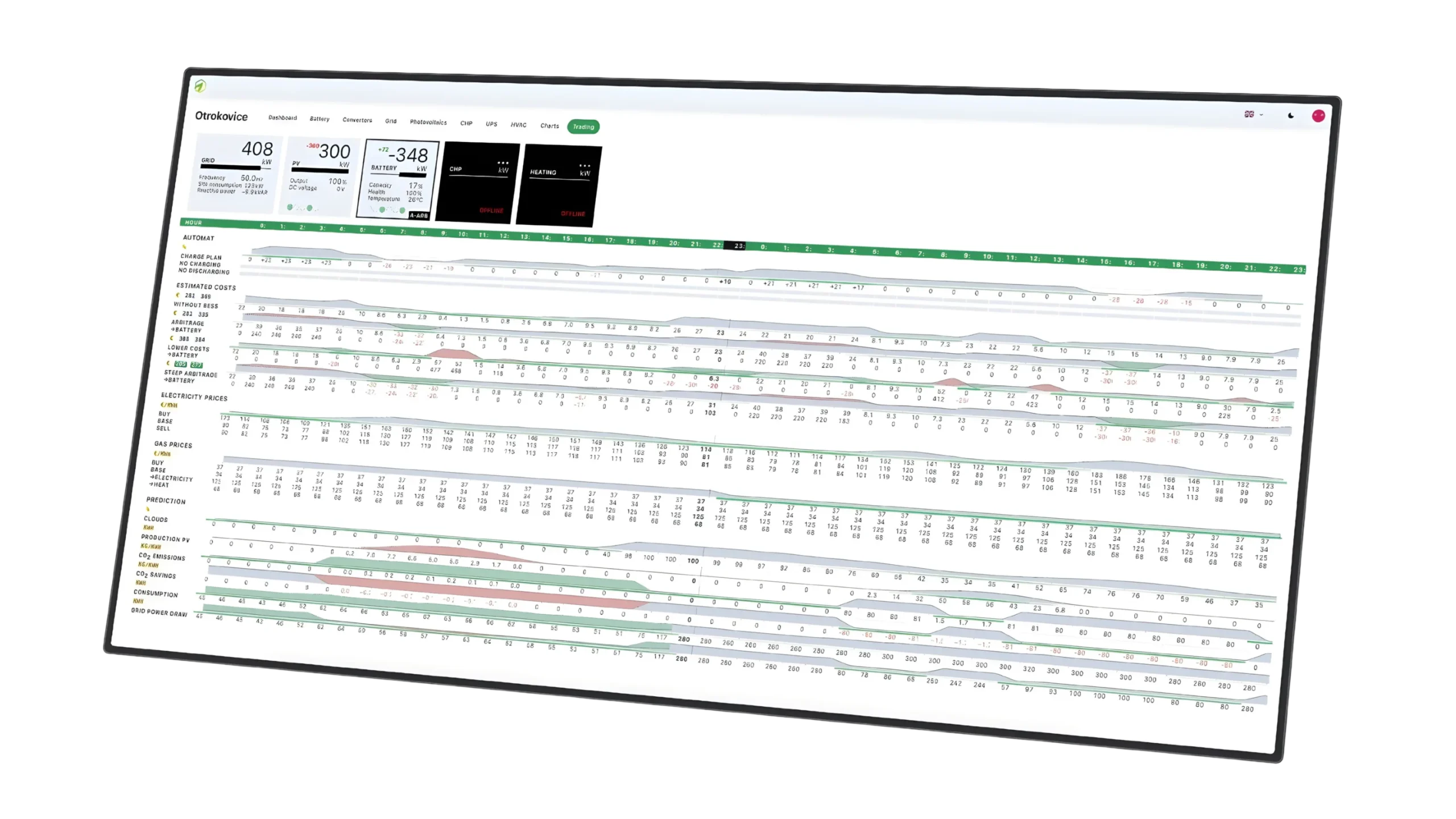
In the upper layer, EMS works with real-time data and predictions—it evaluates electricity and gas prices from the OTE exchange, monitors weather forecasts and expected PV production, plans consumption for the site, and can estimate the energy balance in advance. Based on this information, it decides when it is advantageous to charge the battery, when to store energy for its own consumption, and when to automatically sell the surplus. This significantly shortens the return on investment, as the storage facility not only provides technical support for the site, but also acts as an active economic element.
EMS also coordinates the operation of photovoltaic power plants, batteries, cogeneration units, vehicle charging, and heating equipment. It can calculate when it is advantageous to generate heat from cogeneration units, when to store energy, when to purchase it cheaply at low or negative prices, and when it is effective to change the flow of energy to the grid. This ability to make automatic decisions and optimize trading can reduce the return on investment of storage even further compared to conventional systems.
Our EMS includes our own SCADA, which unifies all technologies into a single, clear interface. It enables detailed monitoring of BESS, PV, KGJ, charging stations, and other devices, including working with historical data and remote control. We can connect to the customer's existing SCADA systems or replace them with our solution and connect data from already installed and newly delivered technologies into a single unit.
Whenever additional machines that require high power for a short period of time are switched on during production, this is reflected in your electricity bill. Battery storage provides additional energy and covers short-term peaks in consumption. You can thus reduce the power consumption you have reserved with your energy provider and save money.
Advantages:
Suitable for industrial enterprises, especially manufacturing and energy-intensive companies.
In areas with insufficient electrical grid coverage, a combination of electrical power sources can be used. (PV, KGJ, etc.) and battery (BESS). Excess electrical energy is stored in it at times when its production exceeds consumption (for example, when the sun is shining and consumption is not so high), and this energy is consumed at times when consumption is higher than what the connected source is capable of producing.


We'll call or meet and go over your goals, needs and vision for a solution.
We will assess the limits and opportunities, prepare a technology proposal and calculate the return.
We will help you with the necessary documentation and permits, if required.
We provide complete installation, system configuration and commissioning.
We will test the battery storage and put it into official use
We monitor the operation of the storage facility and ensure its regular servicing.